
Quick Summary
Cleaning removes dirt, dust, and visible grime from a surface, while disinfection targets the germs and bacteria that cleaning alone can leave behind. The two work best together, since disinfectants need a clean surface to work effectively and cleaning alone doesn’t kill most pathogens. Knowing when each one matters helps a home or office stay genuinely healthier, not just visibly tidy.
A kitchen counter can look spotless and still carry bacteria that a quick wipe-down never touched. Cleaning and disinfection often get treated as the same task, but they solve two different problems, and skipping one in favor of the other leaves a noticeable gap in how healthy a space is.
This holds true in a busy New York City apartment just as much as in a larger home, since smaller spaces see the same daily buildup of germs packed into less square footage. Understanding what each process accomplishes makes it easier to know which one a surface needs, and when both are worth doing together.
What Cleaning Does
Cleaning removes dirt, dust, food particles, and visible grime from a surface using soap, water, or a general-purpose cleaner. This process physically lifts debris away rather than killing what’s underneath it, which is why a surface can look clean while still carrying bacteria or viruses that cleaning alone doesn’t address.
Cleaning also plays a role beyond appearance, since removing built-up grime and organic residue gives disinfectants a better chance to work once they’re applied. Without this first step, a disinfectant applied over dirt or grease has less contact with the actual surface underneath, which lowers how well it performs.
What Disinfection Does
Disinfection uses chemical agents or methods like UV-C light disinfection to kill germs, bacteria, and viruses on a surface, targeting what cleaning alone leaves behind. Unlike cleaning, disinfection doesn’t necessarily remove visible dirt or grime, which is why it works best as a follow-up step rather than a replacement for regular cleaning.
Different disinfection methods target different pathogens, and contact time, meaning how long a disinfectant needs to sit on a surface, plays a big role in how effective the process ends up being.
Why Cleaning Has to Come First
Disinfectants struggle to reach and kill germs when a surface is still coated in dirt, grease, or organic residue, since that buildup acts as a barrier between the disinfectant and the germs underneath.
Skipping straight to disinfection without cleaning first often leaves a surface less protected than expected, even after using a strong product. This is part of why most professional cleaning routines treat disinfection as a step that follows cleaning, not one that replaces it.
When Disinfection Matters Most
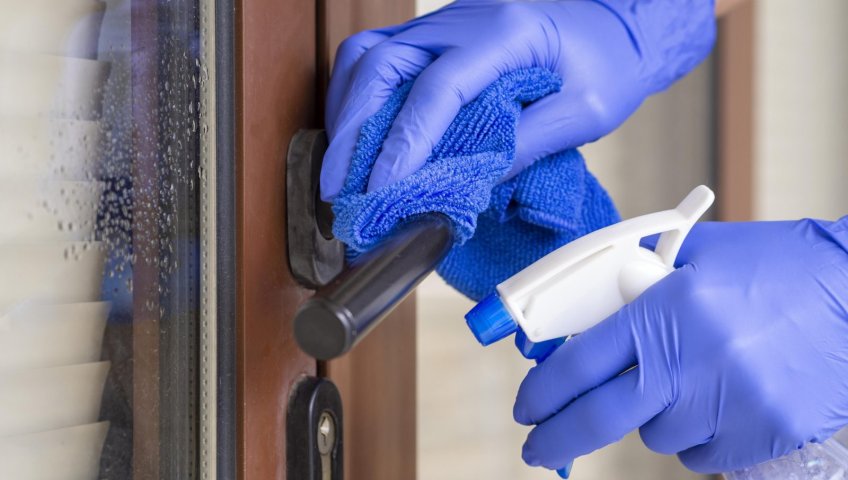
Some situations call for disinfection beyond a standard cleaning routine, particularly high-touch surfaces like doorknobs, light switches, and countertops that see frequent contact throughout the day. Households with someone who is sick, recovering from an illness, or managing a weakened immune system also benefit from more frequent disinfection on top of regular cleaning.
Bathrooms and kitchens, where bacteria tends to concentrate, generally need disinfection more often than lower-traffic areas like a home office or guest room. Shared spaces like a lobby or building entrance, common in many NYC apartment buildings, also see enough daily contact to justify more frequent disinfection than a private room would need.
Using Both Together for a Healthier Space
The most effective approach combines both processes rather than treating them as interchangeable. A regular cleaning routine handles the day-to-day dirt and buildup, while periodic disinfection targets the germs that cleaning alone can’t fully remove.
Pairing the two keeps a space looking clean and reduces the presence of bacteria and viruses that aren’t visible but still shape how healthy a home or office is.
Add UV Disinfection to Your Next NYC Cleaning
At Maid Sailors, our regular and deep cleaning services handle the dirt, dust, and grime first, and our UV-C disinfection add-on follows up by targeting up to 99.9% of viruses, bacteria, allergens, and mold on surfaces and in the air. Depending on what your space needs, we offer a handheld UV wand for high-touch points like doorknobs and light switches, or a larger rotating lamp for more complete coverage across a room.
All our UV equipment is ozone-free and tested for safety, and our cleaners take precautions to protect themselves and your home during the process. This service is available across our New York City locations as an add-on to any booking, priced transparently with no hidden fees. Book your cleaning and disinfection service with Maid Sailors today and cover both halves of a genuinely healthy space.
FAQs
Does disinfection replace the need for regular cleaning?
No. Disinfection kills germs and bacteria on a surface, but it doesn’t remove dirt, dust, or grime the way cleaning does. Most surfaces need both, with cleaning coming first to prepare the surface for disinfection.
How does UV-C disinfection work?
UV-C light is a wavelength of ultraviolet light that disrupts the DNA of bacteria and viruses on contact, preventing them from reproducing. It’s applied to surfaces and, in some cases, the air in a room using a wand or lamp.
Which areas of a home need disinfection most often?
High-touch surfaces like doorknobs, light switches, and countertops benefit most from frequent disinfection, along with bathrooms and kitchens where bacteria tends to build up faster than in lower-traffic rooms.